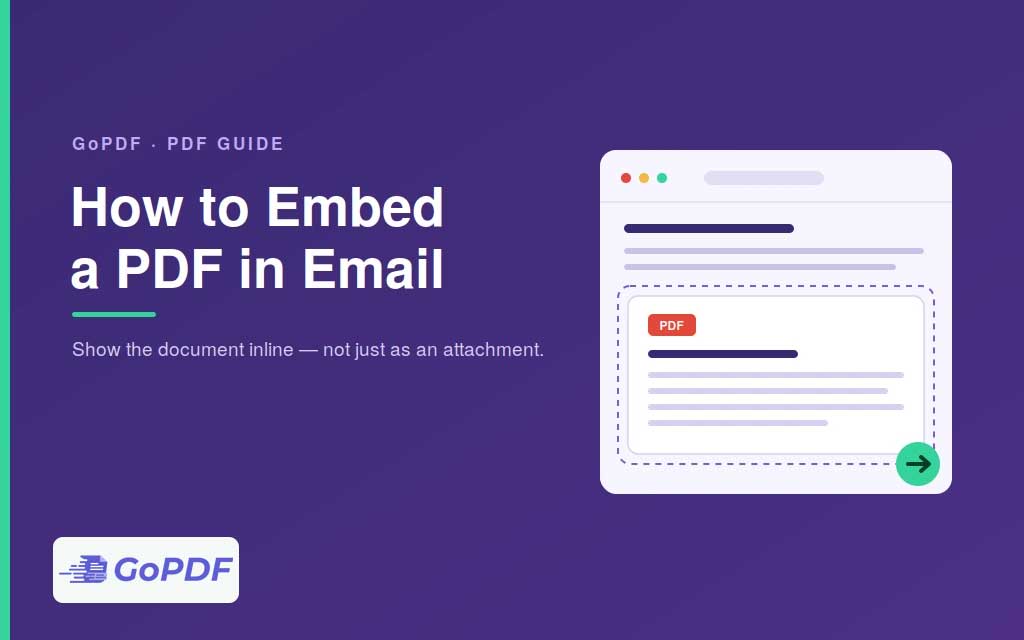
“Embedding” a PDF in email means different things to different people, and the confusion causes most of the frustration around it. Some want the PDF to appear inside the message body so the recipient sees it without opening anything. Others simply want to attach the file. True inline embedding of a full PDF isn’t something email reliably supports — understanding why points you to the approaches that actually work.
Why You Can’t Truly “Embed” a PDF in an Email Body
Email messages are built from HTML, and HTML email is far more restricted than a web page. Email clients strip out iframes, scripts, and most embedding tags for security, and they render content inconsistently across providers. A PDF is a separate document format that email bodies can’t display natively. So the realistic options aren’t “embed the PDF” but “attach it,” “show a preview image of it,” or “link to it.”
The Three Approaches That Work
Attach the file (most common)
Attaching is the standard, reliable method: the PDF rides along with the message and the recipient opens or downloads it. Every email client supports attachments. The constraints are size limits (typically around 20–25 MB per message) and the fact that the recipient must take an action to view it.
Insert a preview image linked to the PDF
To make the document appear in the body, export the PDF’s first page (or a representative page) as an image, insert that image inline, and hyperlink it to the actual PDF — hosted on cloud storage or attached. Recipients see a visual preview in the message and click through to the full document. This is the closest practical equivalent to “embedding.”
Link to a hosted PDF
For large files or wide distribution, upload the PDF to cloud storage and paste a link. This avoids size limits entirely, lets you update the file without resending, and often gives you access tracking. The tradeoff is that the recipient needs connectivity and trusts the link.
A Practical Decision Workflow
- Small file, one recipient, must arrive with the message → attach it.
- Want it to look embedded → insert a clickable preview image linked to the file.
- Large file or many recipients → host it and share a link.
- File near the size limit → compress it before attaching, or switch to a link.
- Sensitive content → prefer a link with access controls over a freely forwardable attachment.
Common Mistakes and Edge Cases
- Expecting the PDF to render in the body: email clients won’t display a PDF inline. Use a preview image plus a link to simulate it.
- Exceeding attachment limits: oversized PDFs bounce or get rejected. Compress first or use a hosted link.
- Preview image with no link: a screenshot alone leaves recipients unable to read the rest. Always link the image to the full file.
- Broken images in some clients: many email clients block images by default, so the preview may not load — keep a clear text link as backup.
- Forwarding risk: attachments are easy to forward. For confidential PDFs, a permissioned link is safer.
- Spam triggers: large attachments and certain link patterns can push a message toward spam filters.
Frequently Asked Questions
Can I make a PDF show up inside the email itself?
Not as a live document — email clients don’t render PDFs inline. The practical equivalent is inserting a preview image of a page and linking it to the full file.
What’s the maximum size I can attach?
Most providers cap attachments around 20–25 MB per message. For larger files, compress the PDF or share a cloud link instead.
How do I show a preview without making the recipient download anything?
Export a page as an image, place it in the message body, and hyperlink it to the hosted or attached PDF.
Is a link or an attachment better?
Attachments guarantee delivery with the message; links handle large files, allow updates, and offer better control for sensitive documents.