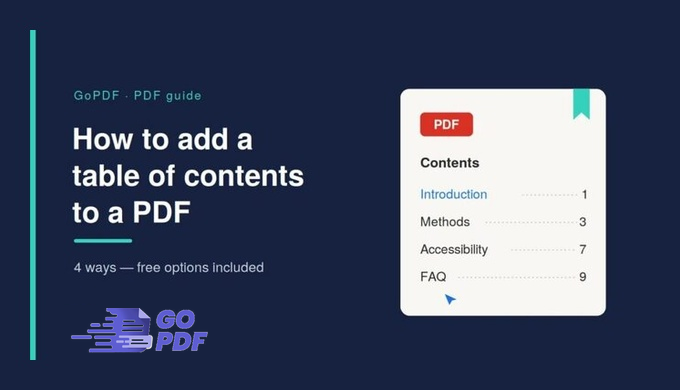
A table of contents (TOC) turns a long PDF into something people can actually navigate. A PDF is a Portable Document Format file defined by the ISO 32000 standard, and the TOC is the map that lets readers jump straight to the section they need.
Inside a PDF, the TOC sits alongside two related elements: the document outline (its bookmarks) and the internal hyperlinks that connect each entry to its section. That overlap is why “table of contents” can mean two different things, and the method you choose depends on which one you want:
- A clickable TOC page inside the document, where each entry jumps to the right section.
- A bookmarks panel (also called the outline), the sidebar list readers use to move through the file.
Good PDFs often have both. Below are four ways to add them, from the fastest to the most precise, with the free options called out.
The fastest way to add a Table of Contents to a PDF (3 steps):
- Open your document in an online PDF edit GoPDF, or in Word, Acrobat, or Google Docs.
- Insert a table of contents built from your headings (so each entry links to its section).
- Save or export as a PDF with bookmarks enabled — your TOC stays clickable.
That’s the short version. Before the step-by-step, it helps to be clear on which of those two elements — the on-page TOC or the bookmarks outline — you actually need, because the tools below produce them differently.
Clickable TOC vs. bookmarks: which one do you need?
A clickable table of contents lives on a page of the document. A reader sees “Chapter 3 …… 24” and clicking it jumps to page 24. This is what most people mean and what you’d print or share.
Bookmarks are the collapsible outline in the PDF viewer’s side panel — often labelled the navigation pane. They don’t appear on any page; they’re a navigation aid, and they’re also the structure that screen readers such as JAWS, NVDA, and VoiceOver use to move through a document.
For a polished document, add both: a clickable TOC page for readers and a bookmarks panel for fast navigation and accessibility. The methods below produce one or the other (and often both at once). We’ll start with the fastest, no-install route and work toward the most precise.
Method 1: Add a clickable TOC online with GoPDF (no install)
If you don’t want to open desktop software, an online editor is the quickest route:
- Upload your PDF to GoPDF.
- Add a table of contents and point each entry to the right page or heading.
- Download the finished PDF — the entries stay clickable.

This works on any device with a browser and needs nothing installed. As with any online tool, upload only documents you’re comfortable sending to a third-party service; for confidential files, use one of the offline methods below.
Best for: a quick, clickable TOC without installing anything.
If, instead, your document still lives in a word processor rather than a finished PDF, it’s cleaner to generate the table of contents at the source — which is where Word comes in.
Method 2: Build a clickable TOC in Microsoft Word, then export
Word is the most reliable way to generate a linked TOC, because it builds it from your heading styles automatically:
- Apply Heading 1 / Heading 2 styles to your section titles.
- Place your cursor where the TOC should go, then go to References → Table of Contents and insert an automatic table.
- Export with File → Save As → PDF (or Export). In the options, enable “Create bookmarks using: Headings” so the PDF gets both a clickable TOC and a bookmarks panel.
If your content already lives in Word, this is the cleanest path and it’s free if you have Office. Google Docs works the same way — insert a TOC, then download as PDF.
Best for: documents you’re authoring or editing in Word/Docs.
When the original source file is gone and all you have is the PDF itself, you need an editor that works on the document outline directly — and that’s Adobe Acrobat’s strength.
Method 3: Add bookmarks (and links) in Adobe Acrobat
Acrobat is best when you’re working from an existing PDF and want precise control over the bookmarks panel:
- Open the PDF and show the Bookmarks panel.
- Select the text or page for a section, then add a bookmark (you can also auto-generate bookmarks from the document’s structure).
- To make an on-page TOC clickable, use the link tool to draw a link over each entry and set it to jump to the matching page.
Acrobat excels at the bookmarks/outline panel; for a full on-page TOC, many people still build it in Word (Method 2) and use Acrobat to refine the links and bookmarks.
Best for: precise control over an existing PDF. Note: Acrobat is paid.
Method 4: Free alternatives without Adobe
You don’t need Adobe to do this. Free options include:
- GoPDF or other online editors for a quick clickable TOC.
- LibreOffice Writer — insert a TOC, then export to PDF with bookmarks (fully offline and free).
- Google Docs — add a table of contents and download as a PDF; the links carry over.
Best for: anyone avoiding paid software.
Make your table of contents accessible
Accessible PDFs start with structure. For a table of contents to work for screen-reader users, the PDF must be a tagged PDF built on a real heading structure — semantic tags, not just visually styled text.
The bookmarks do the navigating. When you build the TOC from genuine heading styles (Methods 1–2) and keep the exported bookmarks, the document outline gives assistive technology like JAWS or NVDA a way to move through the document section by section.
Several standards require this. A tagged, navigable TOC is what PDF/UA (ISO 14289), the WCAG guidelines, and, for US public bodies, Section 508 expect — so for school, government, or public audiences it isn’t optional. In Acrobat you can verify it with the accessibility checker; in Word, starting from real heading styles does most of the work for you.
A table of contents, then, is rarely a one-off task — it’s one piece of getting a PDF into shape, which is worth seeing in context.
Where a table of contents fits in your PDF workflow
Adding a table of contents usually comes near the end of preparing a document, once the structure is settled. It rarely happens in isolation — it’s one step among the common tasks people perform on the same file.
Those tasks connect naturally. You might merge several PDFs into one report and then add a TOC so readers can find each part, remove unwanted pages to tidy up the sections before outlining them, or compress a PDF before sharing the finished, navigable version.
Tools like GoPDF, Word, and Acrobat each cover several of these steps, so you can often handle the whole sequence in one place rather than juggling separate apps.
Which method should you use?
| Your situation | Best method | Cost | Keeps file offline? |
| Quick clickable TOC, no install | GoPDF (Method 1) | Free tier | No |
| You’re writing in Word/Docs | Word or Google Docs (Method 2) | Free–paid | Yes (Word) |
| Editing an existing PDF precisely | Adobe Acrobat (Method 3) | Paid | Yes |
| Free + offline | LibreOffice Writer (Method 4) | Free | Yes |
| Confidential document | Word, LibreOffice, or Acrobat | Free–paid | Yes |
Frequently asked questions
How do I add a table of contents to an existing PDF?
Open it in an online editor like GoPDF or in Adobe Acrobat, add the TOC or bookmarks, and link each entry to the right page. If you have the original Word file, it’s easier to add the TOC there and re-export.
How do I display a table of contents in a PDF?
The clickable TOC appears on a page in the document; the bookmarks outline appears in the viewer’s side panel. Most PDF readers show the bookmarks panel via a sidebar icon.
How do I create a PDF with a table of contents?
Build your document with heading styles in Word, Google Docs, or LibreOffice, insert an automatic table of contents, then export to PDF with bookmarks enabled so the entries stay clickable.
How do I add a table of contents in Adobe Acrobat?
Use the Bookmarks panel to create the outline, and the link tool to make on-page TOC entries jump to their sections. For a full on-page TOC, many users build it in Word first and refine it in Acrobat.