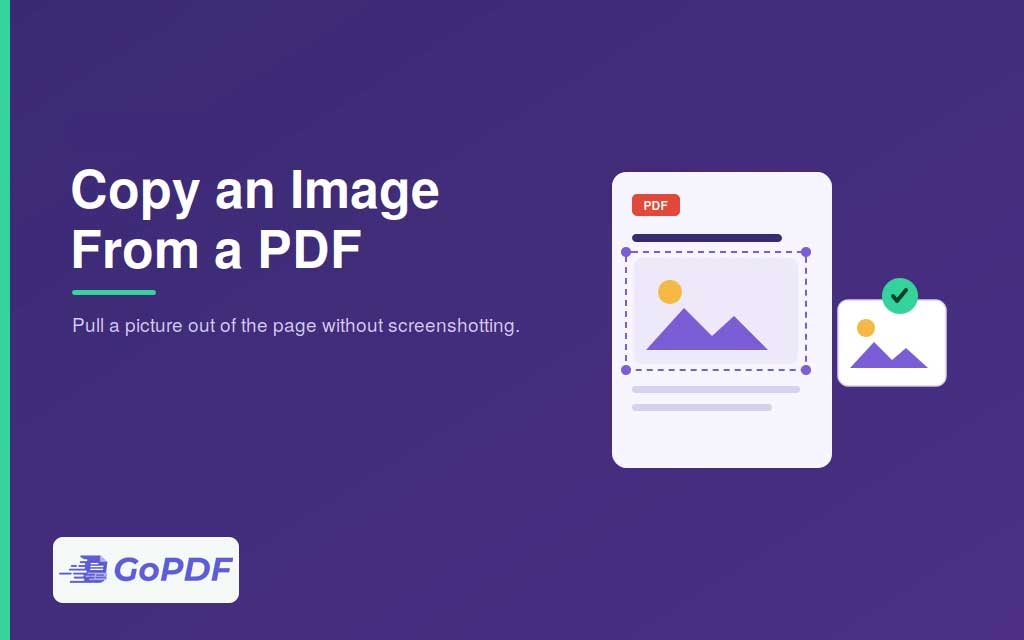
Pulling a figure, chart, or technical drawing out of a PDF sounds trivial until you try it and the image won’t select, or it copies at a disappointingly low resolution. The reason is that a PDF can store a picture in two fundamentally different ways — as a raster image (a grid of pixels) or as vector graphics (mathematical lines and shapes). Diagrams and engineering drawings are very often vector, and that distinction changes which extraction method preserves quality.
Raster vs. Vector: Why It Matters
A photograph in a PDF is raster it has a fixed resolution, and copying it gives you exactly those pixels. A flowchart, schematic, or CAD drawing is frequently vector — infinitely scalable, crisp at any size. If you take a screenshot of a vector diagram, you flatten it to pixels and lose that scalability. So the best method depends on what you need: a quick reference copy, or a high-fidelity asset you’ll resize and reuse.
Method 1: Snapshot / Screenshot (fast, any PDF)
Every PDF reader and operating system can capture a rectangular region of the screen. Adobe’s Snapshot tool, macOS’s Shift+Cmd+4, and Windows’ Snipping Tool all copy the selected area to the clipboard as a raster image. This works on any PDF, including scans and protected files, and is perfect for dropping a diagram into an email or slide. The limitation is resolution: you only capture what’s on screen, so zoom in to the maximum readable level before capturing to get the sharpest result.
Method 2: Direct Copy or Export of Embedded Images (best quality for raster)
If the PDF contains genuine embedded raster images, many editors let you right-click an image and Copy Image, or use an Export → Images function that saves every embedded picture at its original resolution. This is far better than a screenshot because you get the full-quality file the author embedded, not a screen-limited capture. Look for “extract” or “export all images” features in your PDF tool.
Method 3: Preserve Vector Diagrams (highest fidelity for line art)
For vector diagrams you want to keep scalable, avoid rasterizing. Convert or export the page (or selected objects) to a vector format like SVG or EPS, or open the PDF in a vector editor (such as a design or illustration program) that can import PDF paths directly. This keeps lines crisp and editable. It’s the right approach for technical drawings, logos, and charts destined for print or further editing.
A Practical Decision Workflow
- Ask what you need: a quick visual reference, or a reusable high-quality asset?
- Quick reference → snapshot tool, zoomed in first.
- Photograph or embedded raster you want at full quality → export/extract embedded images.
- Diagram, schematic, or logo you’ll resize → export as vector (SVG/EPS) or open in a vector editor.
- Scanned PDF → it’s raster regardless; snapshot or export the page as a high-DPI image.
Common Mistakes and Edge Cases
- Screenshotting vector art: it throws away scalability and sharpness. Export to vector instead when quality matters.
- Low-resolution captures: snapshotting at fit-to-window zoom yields a blurry image. Zoom in to 200–400% before capturing.
- Assuming all images extract cleanly: a single visible figure may be stored as several overlapping image fragments, so an extract can produce multiple pieces.
- Protect PDF: content-copy restrictions can disable direct copying; the snapshot method still works because it captures the screen, not the file data.
- Transparency loss: exporting to a format without an alpha channel (like JPG) fills transparent areas with white. Use PNG or a vector format to keep transparency.
- Scanned “diagrams” aren’t vector: a scan of a drawing is just pixels; no method recovers true vector data without redrawing or specialized tracing.
Frequently Asked Questions
Why does my copied image look blurry?
A screenshot only captures on-screen pixels. Zoom in before capturing, or export the embedded image at its original resolution instead.
How do I keep a diagram scalable?
Export it as a vector format (SVG or EPS) or open the PDF in a vector editor. Screenshotting flattens it to fixed pixels.
The PDF won’t let me copy the image — what now?
Copy restrictions block direct extraction, but the snapshot/screenshot method captures the displayed image regardless.
Can I extract all images from a PDF at once?
Yes — many PDF editor include an “export all images” function that saves every embedded raster image at full quality in one step.