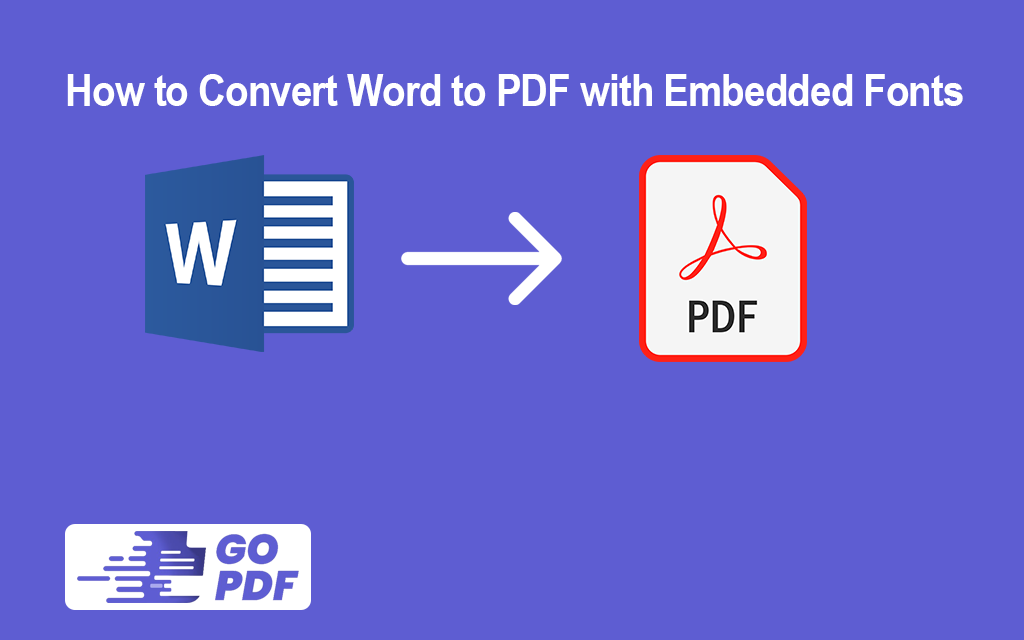
Embedding fonts when you convert Word to PDF means packaging the actual typeface files inside the PDF, so the document displays with your exact fonts on any device — even one that has never had those fonts installed. Without embedding, a PDF only references a font by name and expects the reader’s system to supply it; when the system can’t, it substitutes a different font, and your carefully set headings, spacing, and line breaks shift.
The reason this matters is that a PDF is supposed to be the format that looks identical everywhere, and embedding is the mechanism that makes that promise true for text. A PDF that merely names “Calibri” is gambling that every recipient has Calibri; a PDF with Calibri embedded carries it along and never has to gamble. That single distinction — referenced versus embedded — is what separates a PDF that survives the trip from one that quietly falls apart on someone else’s screen.
How Font Embedding Actually Works
When a PDF is created, each font can be handled in one of three ways, and knowing which you got explains every font problem you’ll ever hit. The font can be fully embedded (the complete typeface travels inside the file), subset-embedded (only the specific glyphs the document uses are included, to save space), or not embedded (only the name is referenced). Most well-made PDFs use subsetting, which is why a font can be “embedded” yet still cause trouble if someone tries to edit the file and types a character the subset didn’t include.
There’s a constraint the how-to pages almost never mention: not every font is legally embeddable. Fonts carry embedding permissions set by their foundry, ranging from fully embeddable to “preview/print only” to “no embedding allowed.” A converter that respects these flags will refuse to embed a restricted font, silently substituting it instead — so your PDF can look wrong through no fault of your settings. And the deeper point: embedding is decided at the moment of conversion, by the tool doing the PDF to word step. You cannot reliably add a font afterward if it was never embedded and the source is gone, because the glyph data simply isn’t in the file. Get it right during conversion, or expect to redo it.
When Embedded Fonts Actually Matter
For a quick internal memo, font substitution rarely matters. The stakes rise sharply in specific situations, and recognizing yours tells you how careful to be.
- Commercial printing — a print shop’s RIP will substitute or reject a file with missing fonts, so embedding (often via PDF/X) is mandatory for anything going to press.
- Branded documents — a proposal in your company’s custom typeface looks unprofessional if it opens in Times New Roman on the client’s machine.
- Forms and legal filings — shifted text from a substituted font can change pagination or push content off a signature page.
- Non-Latin and special characters — documents with accents, symbols, or non-English scripts break badly when the substitute font lacks those glyphs.
A concrete example that surprises people: a designer sends a brochure in a licensed display font to a printer, the printer’s system doesn’t have it, and without embedding the headline silently reflows into a default font — discovered only after a thousand copies are printed. The lesson the top results underplay: embedding isn’t a nicety for important documents, it’s the difference between the file you approved and the file that actually prints.
Types of Font Embedding and Their Trade-offs
“Embed the fonts” hides several outcomes, and each has a cost in file size, editability, or compatibility.
| Embedding type | What’s included | Trade-off |
|---|---|---|
| Full embedding | The entire typeface | Largest file; fully editable text |
| Subset embedding | Only the glyphs used | Smaller file; editing may hit missing glyphs |
| No embedding | Just the font name | Smallest file; substitution risk on other devices |
| Outlining (converting text to shapes) | Text becomes vector paths | Guaranteed appearance; text no longer selectable or searchable |
The option people forget is outlining — turning text into vector outlines so no font is needed at all. It guarantees the look but destroys the text layer, meaning no copying, no searching, and no accessibility. It’s a last resort for a restricted font headed to print, not a general solution. For everything else, full or subset embedding is the right call, with subsetting the sensible default for file size.
Embedding vs Substitution vs Outlining
Three different things can happen to a font on its way into a PDF, and they produce very different results.
| Outcome | What happens to your font | Result |
|---|---|---|
| Embedding | The real font is packaged inside | Looks correct everywhere; text stays live |
| Substitution | The reader swaps in an available font | Spacing and appearance shift |
| Outlining | Text is converted to shapes | Looks correct but text is no longer real text |
The practical hierarchy: embedding is what you want, substitution is what you’re trying to prevent, and outlining is the emergency fallback when a font legally can’t be embedded. If you only remember one thing, it’s that “the fonts look wrong on their computer” almost always means substitution happened — which means embedding didn’t.
Applied Workflows: Converting Word to PDF With Fonts Embedded
Embedding is set during the Word-to-PDF conversion, so the workflow is about choosing the right export path and then verifying the result. Some steps run in the browser through a tool like GoPDF.
Embedding from Microsoft Word directly. Word embeds fonts well if you use the right export. Go to File, then Save As or Export, choose PDF, and — this is the step people miss — open Options and select the standard or PDF/A output, which forces font embedding. On Windows you can also pre-embed fonts into the document itself via File, Options, Save, “Embed fonts in the file,” so they carry through to the PDF. A real sequence: finish the document, export to PDF with PDF/A enabled, then open the result and check the font list.
Converting through a browser tool. If you don’t have Word’s export options or want a quick route, upload the document to a converter such as GoPDF, convert to PDF, and confirm fonts are embedded in the output. This is handy when working on a machine without Office, though you should still verify rather than assume.
Verifying fonts are actually embedded. This is the step every competitor mentions in passing and nobody teaches as a habit. Open the finished PDF, go to the document properties or font information panel, and read the font list — embedded fonts are marked “Embedded” or “Embedded Subset.” If a font shows neither, it wasn’t embedded and will substitute elsewhere. Make this a routine check for anything important; it takes seconds and catches the failure before your recipient does.
Fixing a PDF that’s missing fonts. If you discover a font wasn’t embedded, the reliable fix is to go back to the Word source, ensure the font is installed and embeddable, and re-export — re-converting through a tool like GoPDF if needed. If the source is gone and the font is restricted, outlining the affected text is the fallback to lock the appearance. For confidential documents, note that browser converters upload your file to a server, so weigh that for sensitive material.
Frequently Asked Questions
How do I convert Word to PDF with embedded fonts?
In Word, use File then Export or Save As to PDF, open Options, and choose the standard or PDF/A setting, which forces font embedding. Then open the PDF’s font properties to confirm each font shows as embedded.
How do I check if fonts are embedded in a PDF?
Open the PDF’s document properties and view the font list. Embedded fonts are labeled “Embedded” or “Embedded Subset.” Any font without that label was only referenced and will substitute on devices that lack it.
What’s the difference between full embedding and subsetting?
Full embedding includes the entire typeface, keeping the file fully editable but larger. Subsetting includes only the glyphs the document uses, making the file smaller but potentially causing missing characters if you later edit and type new ones.
Why do my fonts change when I open the PDF on another computer?
The fonts weren’t embedded, so the other device substituted available fonts, shifting spacing and appearance. Re-export from the source with font embedding enabled to fix it.
Why won’t a particular font embed?
Some fonts carry licensing flags that restrict or forbid embedding, so a compliant converter substitutes them instead. For such fonts headed to print, converting the text to outlines is the usual workaround.
Can I embed fonts in a PDF that already exists?
Only partially, and not reliably if the glyph data isn’t in the file. The dependable approach is to re-create the PDF from the original Word document with embedding enabled. If the source is lost and the font is restricted, outlining the text preserves the look.
Do embedded fonts make the PDF bigger?
Yes, somewhat. Full embedding adds the most size, subsetting adds far less by including only used glyphs. The increase is usually worth it for any document where appearance matters.
Are fonts embedded automatically when saving as PDF?
Not always. Some quick “print to PDF” routes skip embedding or subset aggressively. Use the export options that specify standard or PDF/A output, then verify in the font properties rather than assuming.